
Wednesday, 16 January 2013


Tuesday, 8 January 2013
Don't Panic!
If you haven’t been able to buy Mondo Macabro DVDs of late, do not despair. They are not going out of print and MM is not going out of business. Changes in distribution have recently been made, causing a gap in availability with most retailers. The situation will improve, we promise!
Tuesday, 11 December 2012
RIP: José Bénazéraf and Celso Ad Castillo

MEMENTO MORI
We don’t want turn this blog into an obituary column, but as the last couple of weeks has seen the death of two greats from “the wild side of world cinema”, we feel obligated to note their passing.
It’s an indictment of the narrow focus of much film criticism that Celso Ad. Castillo is not better known, but in the Philippines he is generally regarded as one of that country’s most innovative and provocative film makers. Born in 1943, he initially planned to become a lawyer, like his father, but soon gravitated towards the entertainment business as a writer of comic books. In the mid 1960s he began to adapt these as screenplays for the then booming local film market. He directed his first feature in 1965 and his breakthrough came in the early 70s with films starring Fernando Poe Jr, one of the best loved stars of the local industry.
No stranger to scandal, Castillo went on to create provocative stories that mixed sex and religion, both (then as now) explosive subjects in the Philippines. Nympha, Isla and in particular Snake Sisters drew audiences but created controversy. He also made a number of horror films, including the classic Let’s Scare Barbara to Death, starring Fernando Poe Jr’s wife – Susan Roces.

He worked in a dizzying variety of genres: drama, comedy, action, horror, martial arts, sexploitation, etc. His best films are characterised by an almost wilful individuality, touches of visual poetry and an intense desire to move, excite and entertain. Sometimes it works, sometimes it doesn’t. But it’s always fascinating to watch. He will be missed.
I first met José Bénazéraf twenty years ago whilst doing interviews for the Immoral Tales book. He was very hospitable and extremely entertaining, sounding off at the drop of a hat about the mediocrity and moral vacuity of most of his fellow film makers. He was pretty much retired by then, having made and lost several fortunes over the years. He was doing OK, though, living with his wife Simone, an elegant former fashion model, in a luxurious apartment in Neuilly, one of the most desirable of Parisian suburbs. He was very amused when I told him that next on my list of interviewees was Alain Robbe-Grillet, who then lived only two streets away. JB roared with laughter and regaled me with scabrous tales about ARG’s sexual proclivities.
JB could be a crusty old sod and was filled with contradictions (an avowed communist, he lived pretty much the ultimate bourgeois lifestyle, with houses in Paris, Spain and the south of France). His communism, like much of his filmography, seemed to derive from the same source: basically he liked to be a controversialist, that was his life’s blood. He had strong opinions on just about everything and would occasionally phone me to roar down the line his fury at something happening in the UK that he’d read about in the papers. He had been a war hero, although he would never describe himself in that manner, and was still capable of sounding off in a passion about those struggles of far off days, raging at the way certain sections of French society had capitulated to the Nazis. The only ones to truly oppose the oppressors, he maintained, had been the marginals: the gays, the Jews, the Communists.

One of my strongest memories of him is visiting one day and being taken round the corner to a nearby underground garage where was parked his latest toy - a brand new Porsche Cabriolet convertible. With a twinkle in his eye, he insisted we go for a drive and set off down the Champs Elysées at full tilt, top down, yelling at me to check the speed as he couldn’t drive and look at the dash at the same time. Passing a restaurant he knew, he decided we would stop for lunch and skidded to a halt, double parked in the middle of the busy city centre road. As we tucked into almost raw steaks, I had to crane my neck to keep a tab on the Porsche, which was soon surrounded by curious passers by and, eventually, a passing copper, no doubt thinking that it had been abandoned by a teenage car thief. I believe José must have been in his 80s at this point.
He was a force of nature, that’s a description that truly fits him, and as with all forces of nature you never believe they can be finite. But it turns out he was mortal, just like the rest of us.
What can you say about his films? They were reflections of the man who made them. As a catalogue description for his 1963 production Le Concerto de la peur says: “It pricks the conscience, probes the libido and excites the senses!”
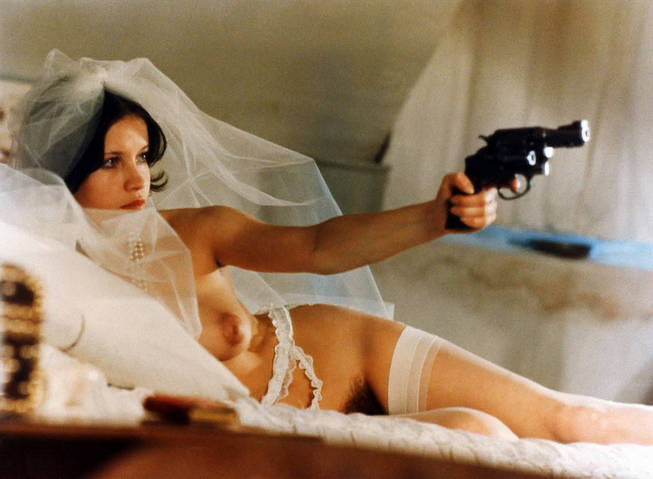
What more can you ask for from wild world cinema?
Celso Ad Castillo, 1943-2012
José Bénazéraf, 1922-2012
- Pete Tombs, December 2012
Monday, 26 November 2012
Just what you need: Another Mondo Macabro Blog!
Blogspot is soooo 2000s. If you want to be hip in the 2010s, you need to be on the Tumblr. Or so the kids tell me. So, in order to continue to try and win over the kids to our side, we have created a new blog to further promote all the wonders of the MM videosphere! It will mostly be a clearing house for provacative archival images from MM releases past, present, and future.
Find it, and follow it, here!

You can continue to check in on this location for breaking news and various MM- and international cult movie-related items.
Find it, and follow it, here!

You can continue to check in on this location for breaking news and various MM- and international cult movie-related items.
Monday, 12 November 2012
The MM Back-Catalog Spotlight Volume 3
At last! A third volume in our on-going series of articles extolling the virtues of MM's many and varied weird-movie DVD releases has arrived! This time, weird-movie blogger extraordinaire Todd Stadtman gazes into the abyss that is SILIP: DAUGHTERS OF EVE and finds that it is definitely gazing back at him.
 The thing about obsessively seeking out offbeat cinema – and drug addiction, I guess – is that inevitably things will start to have less and less of a kick. I may jump like a spring loaded cat at sudden noises on the street, but there is now little in the world of film that can rattle me. Yes, within this tiny little, internet succoured niche that I’ve carved out for myself – if indeed only there – I am a complete badass. Have you made an earnest, SOV serial killer movie that will expose me to the dark side of human nature in unflinching and nihilistically gritty detail? Well, guess what? I am already laughing at you.
It is for this reason that, when I see a movie that jars me as much as Elwood Perez’s Silip did, it tends to stick with me. And Silip has haunted me ever since I first watched it. So much so, in fact, that I wasn’t even sure if I actually liked it until re-watching it recently. This was in part because, as with any strong medicine, “liking” Silip isn’t simply a matter of checking in with your pleasure centers, but a matter of conscious deliberation (does anyone ever actually “like” their first cigarette or shot of whiskey without deciding it so?) – but also in part due to my fear that making the distinction would require me to answer questions that I wasn’t yet prepared to ask myself. For, while there are pleasures to be had within Silip, they are inextricably bound up with punishment. Like the punitive version of Catholicism that inspired it, its every foray into the sensual realm is infused with a guilt so leaden and toxic that it’s impossible to walk away from the film without having some of it stick to you.
It is such tensions and contrasts that make watching Silip so unnerving. Perez gives us moments of intense eroticism, but doles them out between episodes of violence, carnage and self flagellation that are as visceral and deeply disturbing as the former are arousing. Maria Isabel Lopez’s golden body, glistening in a thin layer of perspiration under a teasingly diaphanous shift, is like a fleshy monument to sensuality itself, a marvel to behold. But, in order to behold it, we’ve had to brave an opening sequence depicting the unsimulated bludgeoning and disembowelment of a water buffalo before an audience of wailing children, and thus can only do so with trepidation. Likewise, it’s not long after we’ve been given our first glance at Lopez’s body in all its naked glory that we’re subjected to the sight of her rubbing handfuls of rock salt against her pussy in a fit of deranged penance.
For me, another stark contrast that Silip provided was in how it broke so resoundingly with my previous experience of Filipino cinema. Given the cheeky but affable Tagalog parodies and goofy exploitation movies that I’d indulged myself in, I’d had no idea at the time that there was space within that cinema for something so ferocious. More importantly, the image I’d gotten from those films was one of an all-pervasive Christian piety. One could literally never predict when the narrative of any Filipino movie, regardless of genre, might be interrupted for a moment of religious instruction, be it a scene of the hero kneeling at the altar or a bluntly depicted instance of divine retribution. To my secular mind – and having yet to sample the films of Brocka – dissent from such a monolithic front seemed inconceivable. Yet here was Silip, an angry fable against zealotry, repression and intolerance that, while not necessarily anti-Catholic, didn’t really seem to care that much if it tore the whole house down in the process of remodelling.
 And the contrasts don’t end there, carrying over into Silip’s visual aesthetic. Put simply, the film is beautifully shot. And this despite the fact that the remote and isolated seaside village in which it takes place – a scorching sand patch rife with provincial ignorance, hatred and fear – is depicted as something of a hell on earth. That Perez then chooses to capture that hell in an almost elegiac manner only manages to make things that much more unsettling. Presented in a much less sun dappled light, however, is the plight of the film’s children, who suffer the lack of guidance from the tortured adults on hand and travel down some distinctly troubling paths as a result. It’s fairly typical of Southeast Asian and Filipino films to treat childhood with less sentimentality and idealisation than their Western counterparts, and, in that tradition, Silip, while reflecting appropriate compassion, depicts these kids’ actions with jarring frankness. Suffice it to say that it wouldn’t go down that way in Hollywood, not in a million years.
So, in short, Silip is the rare film with a true capacity to shock, and if you’re a viewer who’s reached my level of jadedness (and given the blog you’re reading, the chances of that are high), that has to count for something. It’s also a film that will make you feel horniness, revulsion, anger, despair and exaltation in such rapid and cyclical succession that it will likely take some time to recalibrate your emotional compass after watching it. Of course, that might not be a menu of sensations that just everyone wants to sign up for, but if you’re feeling like your sensibilities are in need of a little kick start, it could be just the tonic.
As for me, yeah, it turns out that I really do like it after all.
Todd Stadtman writes about world pop cinema on his blog Die, Danger, Die, Die, Kill! and is a regular contributor to Teleport City.
It is for this reason that, when I see a movie that jars me as much as Elwood Perez’s Silip did, it tends to stick with me. And Silip has haunted me ever since I first watched it. So much so, in fact, that I wasn’t even sure if I actually liked it until re-watching it recently. This was in part because, as with any strong medicine, “liking” Silip isn’t simply a matter of checking in with your pleasure centers, but a matter of conscious deliberation (does anyone ever actually “like” their first cigarette or shot of whiskey without deciding it so?) – but also in part due to my fear that making the distinction would require me to answer questions that I wasn’t yet prepared to ask myself. For, while there are pleasures to be had within Silip, they are inextricably bound up with punishment. Like the punitive version of Catholicism that inspired it, its every foray into the sensual realm is infused with a guilt so leaden and toxic that it’s impossible to walk away from the film without having some of it stick to you.
It is such tensions and contrasts that make watching Silip so unnerving. Perez gives us moments of intense eroticism, but doles them out between episodes of violence, carnage and self flagellation that are as visceral and deeply disturbing as the former are arousing. Maria Isabel Lopez’s golden body, glistening in a thin layer of perspiration under a teasingly diaphanous shift, is like a fleshy monument to sensuality itself, a marvel to behold. But, in order to behold it, we’ve had to brave an opening sequence depicting the unsimulated bludgeoning and disembowelment of a water buffalo before an audience of wailing children, and thus can only do so with trepidation. Likewise, it’s not long after we’ve been given our first glance at Lopez’s body in all its naked glory that we’re subjected to the sight of her rubbing handfuls of rock salt against her pussy in a fit of deranged penance.
For me, another stark contrast that Silip provided was in how it broke so resoundingly with my previous experience of Filipino cinema. Given the cheeky but affable Tagalog parodies and goofy exploitation movies that I’d indulged myself in, I’d had no idea at the time that there was space within that cinema for something so ferocious. More importantly, the image I’d gotten from those films was one of an all-pervasive Christian piety. One could literally never predict when the narrative of any Filipino movie, regardless of genre, might be interrupted for a moment of religious instruction, be it a scene of the hero kneeling at the altar or a bluntly depicted instance of divine retribution. To my secular mind – and having yet to sample the films of Brocka – dissent from such a monolithic front seemed inconceivable. Yet here was Silip, an angry fable against zealotry, repression and intolerance that, while not necessarily anti-Catholic, didn’t really seem to care that much if it tore the whole house down in the process of remodelling.

So, in short, Silip is the rare film with a true capacity to shock, and if you’re a viewer who’s reached my level of jadedness (and given the blog you’re reading, the chances of that are high), that has to count for something. It’s also a film that will make you feel horniness, revulsion, anger, despair and exaltation in such rapid and cyclical succession that it will likely take some time to recalibrate your emotional compass after watching it. Of course, that might not be a menu of sensations that just everyone wants to sign up for, but if you’re feeling like your sensibilities are in need of a little kick start, it could be just the tonic.
As for me, yeah, it turns out that I really do like it after all.
Todd Stadtman writes about world pop cinema on his blog Die, Danger, Die, Die, Kill! and is a regular contributor to Teleport City.
Friday, 2 November 2012
EUROTIKA! on YouTube!
Just about the only way to see the uncut episodes of the classic UK TV docu series produced and executed by our own Andy Starke and Pete Tombs is to click here. If you haven't seen this program before, it's an excellent introduction to the wild world of European exploitation cinema during it's heyday of the late 60s through the early 80s. Lots of great clips and thoughtful interviews. Enjoy!
Wednesday, 22 August 2012
MM Back-Catalog Spotlight Vol 2!!
Here's the second in our ongoing series of looks back in time to past DVD treasures, which were unearthed and then celebrated and then forgotten again. Here's a reminder. Blogger/film-maker Jeremy Riddle attempts to get to the heart of our wild double feature of FOR YOUR HEIGHT ONLY and CHALLENGE OF THE TIGER.

He's not that British guy, though.
He is, instead, the Philipines' finest.
He's 2 1/2 feet tall.
He's Weng Weng: Special Agent 00.
See this butt-biting, Moe-do'd moppet tackle the felonious forces of Mr. Giant in FOR YOUR HEIGHT ONLY, another of those fantastically fried flicks with which Mondo Macabro perpetually provides us.
"The forces of good are our sworn enemy, and... they must be exterminated, and I mean lethally."
Mr. Giant's right-hand thug, expressing, with typically inept hilarity, the heartless villainy our diminutive hero must face. Will the Weng-Wengster win out over this comic concoction of sinister slavers, deadly drug-runners, and the merciless miscreant masterminding their malevolent machinations? I guess you'll just have to watch and see.
And, hey, think it's hard to believe, from this description, that such a movie actually exists? Well, after you see it, you _still_ won't believe it.
Alongside Weng's way-off-the-beaten-track exploits comes a compelling chunk of chopsocky cheddar from the Brucesploitation bin. The under-epic CHALLENGE OF THE DRAGON features "Bruce Le"--only one "e"--and Richard Harrison in a silly stew of spies, teeth-grittin' kung fu fightin', and gloriously gratuitous bare breasts. The latter end up in the hands of Harrison, who, with his Burt Reynolds moustache, deals with the booty while "Le" takes on most of the booty-kicking.
CHALLENGE doesn't have as high a WTF Factor as HEIGHT, but it does have its moments--slo-mo topless tennis jumps immediately to mind--and, most importantly, it manages to be damn entertaining, which puts it a chop above most of the Brucesploitation bunko. Paired with HEIGHT, it makes for a fine double-feature for both those looking for something a little different and the seasoned connoisseur of the psychotronic alike.
Jeremy Riddle is a writer and would-be filmmaker who hails from a little place called Ringgold, Georgia, where he's busily building an embryonic indie film colony for no-doubt nefarious purposes. He hopes to have his first, as-yet-untitled feature in the can before the end of the year. Check out his writings on film at his blog The Dig.
If this has whetted your appetite for more, and I'm positive it has, then steal your parent's credit card and head on over to one of these reputable DVD pushers, TLA Cult or Diabolik DVD to pick up your very own copy!

He's a sharp-dressed, kung-fu kicking man of action. With unshakeable courage, unbreachable cool, and an array of clever gadets, he battles dastardly supervillains in exotic locales with the fate of the free world itself at stake. He's clever, quick-witted, tough as nails, a smooth-talking smooth operator who always gets his man. Always gets the ladies, too. A hero for our age.
He's not that British guy, though.
He is, instead, the Philipines' finest.
He's 2 1/2 feet tall.
He's Weng Weng: Special Agent 00.
See this butt-biting, Moe-do'd moppet tackle the felonious forces of Mr. Giant in FOR YOUR HEIGHT ONLY, another of those fantastically fried flicks with which Mondo Macabro perpetually provides us.
"The forces of good are our sworn enemy, and... they must be exterminated, and I mean lethally."
Mr. Giant's right-hand thug, expressing, with typically inept hilarity, the heartless villainy our diminutive hero must face. Will the Weng-Wengster win out over this comic concoction of sinister slavers, deadly drug-runners, and the merciless miscreant masterminding their malevolent machinations? I guess you'll just have to watch and see.
And, hey, think it's hard to believe, from this description, that such a movie actually exists? Well, after you see it, you _still_ won't believe it.
Alongside Weng's way-off-the-beaten-track exploits comes a compelling chunk of chopsocky cheddar from the Brucesploitation bin. The under-epic CHALLENGE OF THE DRAGON features "Bruce Le"--only one "e"--and Richard Harrison in a silly stew of spies, teeth-grittin' kung fu fightin', and gloriously gratuitous bare breasts. The latter end up in the hands of Harrison, who, with his Burt Reynolds moustache, deals with the booty while "Le" takes on most of the booty-kicking.
CHALLENGE doesn't have as high a WTF Factor as HEIGHT, but it does have its moments--slo-mo topless tennis jumps immediately to mind--and, most importantly, it manages to be damn entertaining, which puts it a chop above most of the Brucesploitation bunko. Paired with HEIGHT, it makes for a fine double-feature for both those looking for something a little different and the seasoned connoisseur of the psychotronic alike.
Jeremy Riddle is a writer and would-be filmmaker who hails from a little place called Ringgold, Georgia, where he's busily building an embryonic indie film colony for no-doubt nefarious purposes. He hopes to have his first, as-yet-untitled feature in the can before the end of the year. Check out his writings on film at his blog The Dig.
If this has whetted your appetite for more, and I'm positive it has, then steal your parent's credit card and head on over to one of these reputable DVD pushers, TLA Cult or Diabolik DVD to pick up your very own copy!
Subscribe to:
Posts (Atom)

 Posts
Posts

